Promotions and Activities


 Home
HomeRobotic Pipette Tips Explained: Choosing the Right Tips for Tecan, Hamilton, and Beckman Systems
 2026-07-15
 1
1
Automated liquid handling systems are only as reliable as the consumables they run on.
A robotic tip that mounts inconsistently, seals poorly, or generates aerosol during high-speed dispense will introduce errors that no software calibration can correct. This guide covers what makes robotic pipette tips different from manual tips, how compatibility works across Tecan, Hamilton, and Beckman platforms, and what to look for when sourcing at scale.
Why Automation Requires Higher Precision
Manual pipetting tolerates minor tip variation. A technician adjusts grip pressure, notices a poor seal, and replaces the tip before aspirating.
A robotic arm does not.
Automated liquid handlers mount tips at fixed force and speed, aspirate at programmed volumes, and dispense without any operator feedback loop. A tip with a cone diameter 0.1 mm out of spec will either fail to seat at the robot's standard mounting force, or seat loosely and leak during aspiration — and neither failure will trigger an alert until the downstream assay shows aberrant results.
This is why robotic pipette tips are manufactured to tighter dimensional tolerances than standard manual tips, and why platform-specific geometry matters more than it does on the bench.
Key precision requirements for robotic tips:
●Cone diameter tolerance: ± 0.03 mm or tighter, versus ± 0.05–0.1 mm for manual tips
●Wall thickness uniformity: affects aspiration pressure consistency across a 96- or 384-tip array
●Tip-to-tip height consistency: critical for simultaneous multichannel aspiration from plates
●Low particulate generation: automated systems run in cleanrooms or controlled environments where particle counts matter
Tecan Compatibility
Tecan liquid handlers — including the Freedom EVO, Fluent, and Spark series — use a standard shaft geometry across most models, making tip compatibility more straightforward than some competing platforms.
Tecan-compatible robotic tips are available in 50 µL, 200 µL, and 1000 µL formats. Key specifications to confirm:
●Tip collar diameter must match Tecan DiTi (disposable tip) shaft specification
●Rack footprint must comply with Tecan tip rack dimensions for robotic loading
●Low retention surface treatment is recommended for protein-containing reagents and small-volume transfers where wall adhesion would affect accuracy
Tecan systems also support filtered tips — essential for runs involving volatile reagents, nucleic acids, or any application where aerosol contamination between wells would compromise results.
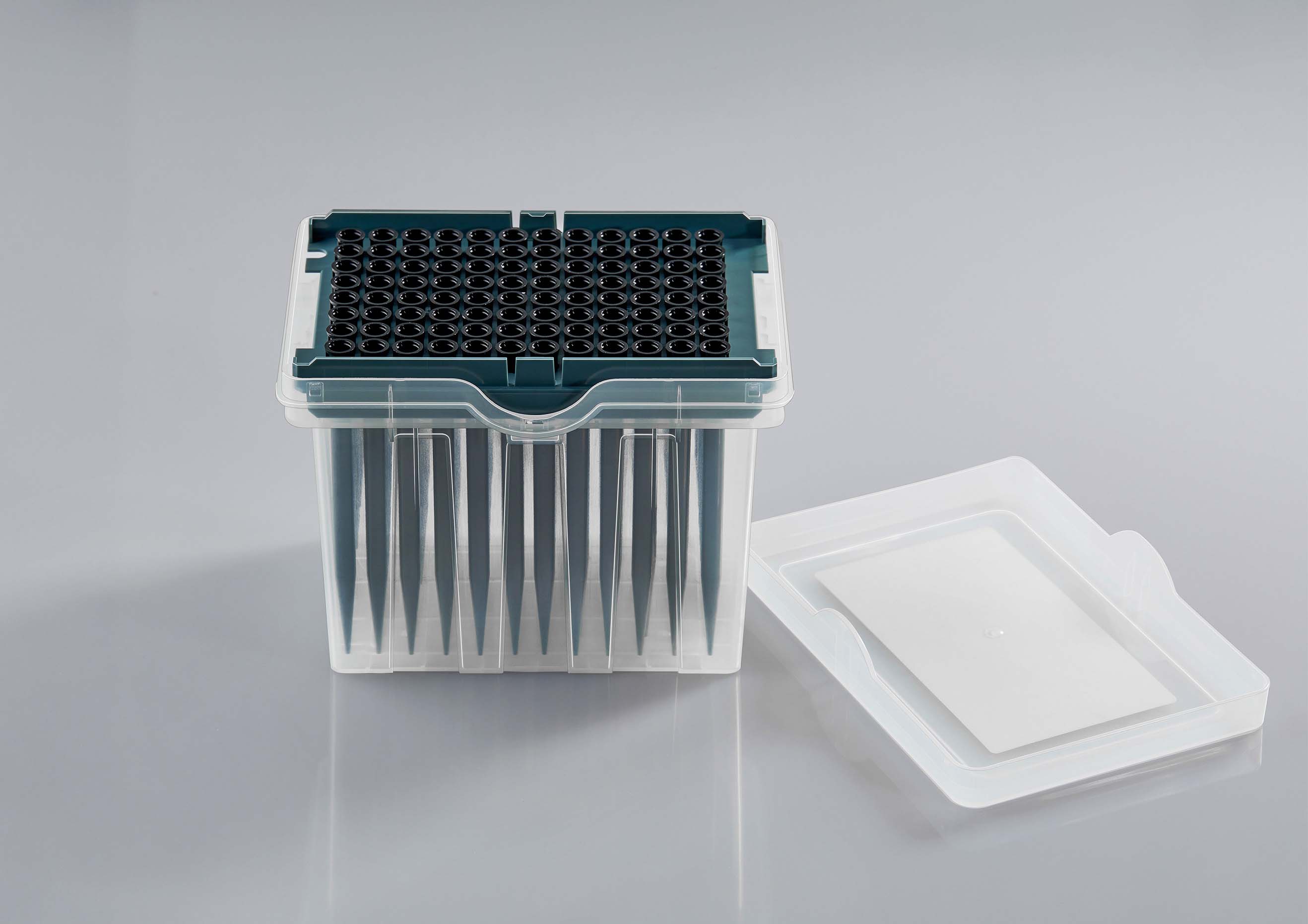
Hamilton Compatibility
Hamilton platforms — including the STAR, STARlet, and Microlab NIMBUS — use a unique tip attachment mechanism that differs from standard friction-cone designs.
Hamilton tips use a CO-RE (Compressed O-Ring Expansion) system, where the pipetting channel expands an internal O-ring to grip the tip from the inside rather than pressing onto an external cone. This means Hamilton-compatible tips require a specific inner geometry — standard universal tips will not work on CO-RE channels.
When sourcing Hamilton-compatible robotic tips, verify:
●Inner bore diameter and CO-RE grip zone dimensions are specified and documented
●Tip rack format matches Hamilton rack specifications (standard SBS footprint with specific height tolerances)
●Volume range covers your assay requirements (Hamilton tips range from 50 µL to 1000 µL depending on the channel type)
Hamilton CO-RE tips are available with and without filters, and in low retention variants for sensitive applications.
Beckman Compatibility
Beckman Coulter liquid handlers — including the Biomek i-Series and FX series — use a standard friction-cone shaft design similar to Tecan but with platform-specific rack and tip height specifications.
Beckman-compatible robotic tips are available in 50 µL, 250 µL, and 1025 µL formats. Rack dimensions must match Beckman's tip loading deck specifications precisely — even a 0.5 mm height variation can cause the robotic arm to miss tips during pickup.
Filtered tips are particularly relevant for Beckman platforms running nucleic acid extraction or PCR setup protocols, where aerosol cross-contamination between samples would compromise every downstream result.
Filter vs Conductive Tips
Two specialized tip formats come up consistently in automation contexts:
Filtered robotic tips contain a hydrophobic aerosol barrier that prevents liquid from entering the pipetting channel during aspiration and dispense. They are required for:
●PCR and qPCR setup
●Nucleic acid extraction
●Volatile or hazardous reagent handling
●Any application where cross-contamination between tips would affect results
Conductive tips are used on platforms that rely on capacitive liquid level detection — where the pipetting system uses the tip as an electrode to detect liquid surfaces. Non-conductive standard tips will prevent this detection from working. Confirm whether your liquid handler uses capacitive liquid level sensing before specifying tip type.
Manufacturing Tolerances
For robotic applications, dimensional documentation is not optional — it is a supplier qualification requirement.
Before approving any robotic tip supplier, request:
●Cone diameter specification with production tolerance range
●Tip height specification with tolerance (critical for simultaneous 96-channel pickup)
●Inner bore diameter for Hamilton CO-RE tips
●Leak rate test data at aspiration pressures matching your platform's operating parameters
●Particulate count data — cleanroom manufacturing should produce tips with minimal particle generation
Reputable manufacturers produce robotic tips in Class 8 cleanrooms with fully automated injection molding, minimizing human handling and associated contamination. Biological safety certifications — RNase-free, DNase-free, pyrogen-free, ATP-free — should come with lot-specific test reports, not just general product claims.
OEM Supply Advantages
For distributors and instrument manufacturers bundling tips with automated systems, OEM robotic tip supply offers several advantages over off-the-shelf purchasing:
●Custom rack labeling — branded packaging with your catalog numbers and instrument compatibility references
●Platform-specific SKU structure — separate product lines for Tecan, Hamilton, and Beckman compatibility, clearly differentiated in your catalog
●Bulk pricing tiers — robotic tip consumption in high-throughput labs runs to tens of thousands of tips per week; volume pricing structures matter
●Consistent lot production — qualified OEM manufacturers maintain the same tooling and process parameters across production runs, eliminating inter-lot dimensional variation that would require requalification
PakGent Bio manufactures robotic pipette tips for Tecan, Hamilton, and Beckman platforms, produced in ISO Class 7 and 8 cleanrooms, certified RNase/DNase-free and pyrogen-free, available in Rack, Refill, and Bulk packaging with full OEM and private label capability.